1
/
of
4
Uploader
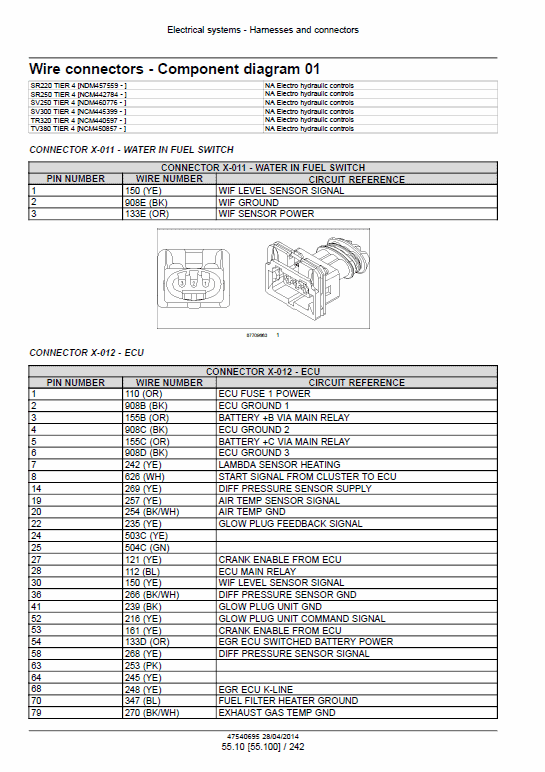
Case SR220, SR250, SV250, SV300 SkidSteer Service Manual (Tier 4A) Workshop Guide
Case SR220, SR250, SV250, SV300 SkidSteer Service Manual (Tier 4A) Workshop Guide
Regular price
$63.00 USD
Regular price
Sale price
$63.00 USD
Taxes included.
Shipping calculated at checkout.
Quantity
.
In Stock
Couldn't load pickup availability
Format : PDF
SUPPLIED AS DOWNLOADABLE LINK
Manual Included:
•
Service Manual:
2091 pages & 2061 pages
Specifications:
•
Brand:
Case
•
Model:
SR220 (PIN: NDM457559 and above) (Tier 4A)
SR250 (PIN: NCM442784 and above) (Tier 4A)
SV250 (PIN: NDM460776 and above) (Tier 4A)
SV300 (PIN: NCM445399 and above) (Tier 4A)
•
Type:
SkidSteer
•
Manuals:
Service Manual
•
Publication Numbers:
47540695 (April 2014) and 47674604
•
Language:
English
•
Format:
PDF
Description
Table of Contents
Contents
Introduction
Engine
Front Axle System
Rear Axle System
Hydrostatic Drive
Brakes and Controls
Hydraulic Systems
Frames and Ballasting
Wheels
Cab Climate Control
Electrical System
Front Loader and Bucket
Platform, Cab, Bodywork and Decals
Specials Tool Index
Manual Extract:
Brake control solenoids – Overview
Solenoids work in much the same way as relays, except that the iron core is not fixed in place. As a result, the windings in the control circuit cause the iron core to move. In the starting system, for example, the movement of this core is used to send large amounts of current to the starter motor.
A solenoid is basically a winding around an iron core. In the Centre of the core there is a plunger which is free to move through the core. When an electrical current passes through the winding an electro-magnetic force is produced which causes the plunger to move through the core. If the current is switched off, the magnetic force is stopped and the plunger is returned by a spring.
The solenoid plunger may have different uses: the most common are moving a hydraulic spool or a mechanical lever.
The MOST COMMON FAULTS that can occur are:
• Short circuit winding: if a section of the winding allows the current to pass directly from positive (+) to negative (-) terminals without passing through the winding, this will cause the relevant circuit fuse to blow.
• Broken winding: causing an open circuit, it will not allow the current to pass through the winding, so the solenoid will not operate.
• Seized plunger (and/or connected components): the solenoid will only move the plunger if all components are free to move.
SUPPLIED AS DOWNLOADABLE LINK
Manual Included:
•
Service Manual:
2091 pages & 2061 pages
Specifications:
•
Brand:
Case
•
Model:
SR220 (PIN: NDM457559 and above) (Tier 4A)
SR250 (PIN: NCM442784 and above) (Tier 4A)
SV250 (PIN: NDM460776 and above) (Tier 4A)
SV300 (PIN: NCM445399 and above) (Tier 4A)
•
Type:
SkidSteer
•
Manuals:
Service Manual
•
Publication Numbers:
47540695 (April 2014) and 47674604
•
Language:
English
•
Format:
Description
Table of Contents
Contents
Introduction
Engine
Front Axle System
Rear Axle System
Hydrostatic Drive
Brakes and Controls
Hydraulic Systems
Frames and Ballasting
Wheels
Cab Climate Control
Electrical System
Front Loader and Bucket
Platform, Cab, Bodywork and Decals
Specials Tool Index
Manual Extract:
Brake control solenoids – Overview
Solenoids work in much the same way as relays, except that the iron core is not fixed in place. As a result, the windings in the control circuit cause the iron core to move. In the starting system, for example, the movement of this core is used to send large amounts of current to the starter motor.
A solenoid is basically a winding around an iron core. In the Centre of the core there is a plunger which is free to move through the core. When an electrical current passes through the winding an electro-magnetic force is produced which causes the plunger to move through the core. If the current is switched off, the magnetic force is stopped and the plunger is returned by a spring.
The solenoid plunger may have different uses: the most common are moving a hydraulic spool or a mechanical lever.
The MOST COMMON FAULTS that can occur are:
• Short circuit winding: if a section of the winding allows the current to pass directly from positive (+) to negative (-) terminals without passing through the winding, this will cause the relevant circuit fuse to blow.
• Broken winding: causing an open circuit, it will not allow the current to pass through the winding, so the solenoid will not operate.
• Seized plunger (and/or connected components): the solenoid will only move the plunger if all components are free to move.
Share